
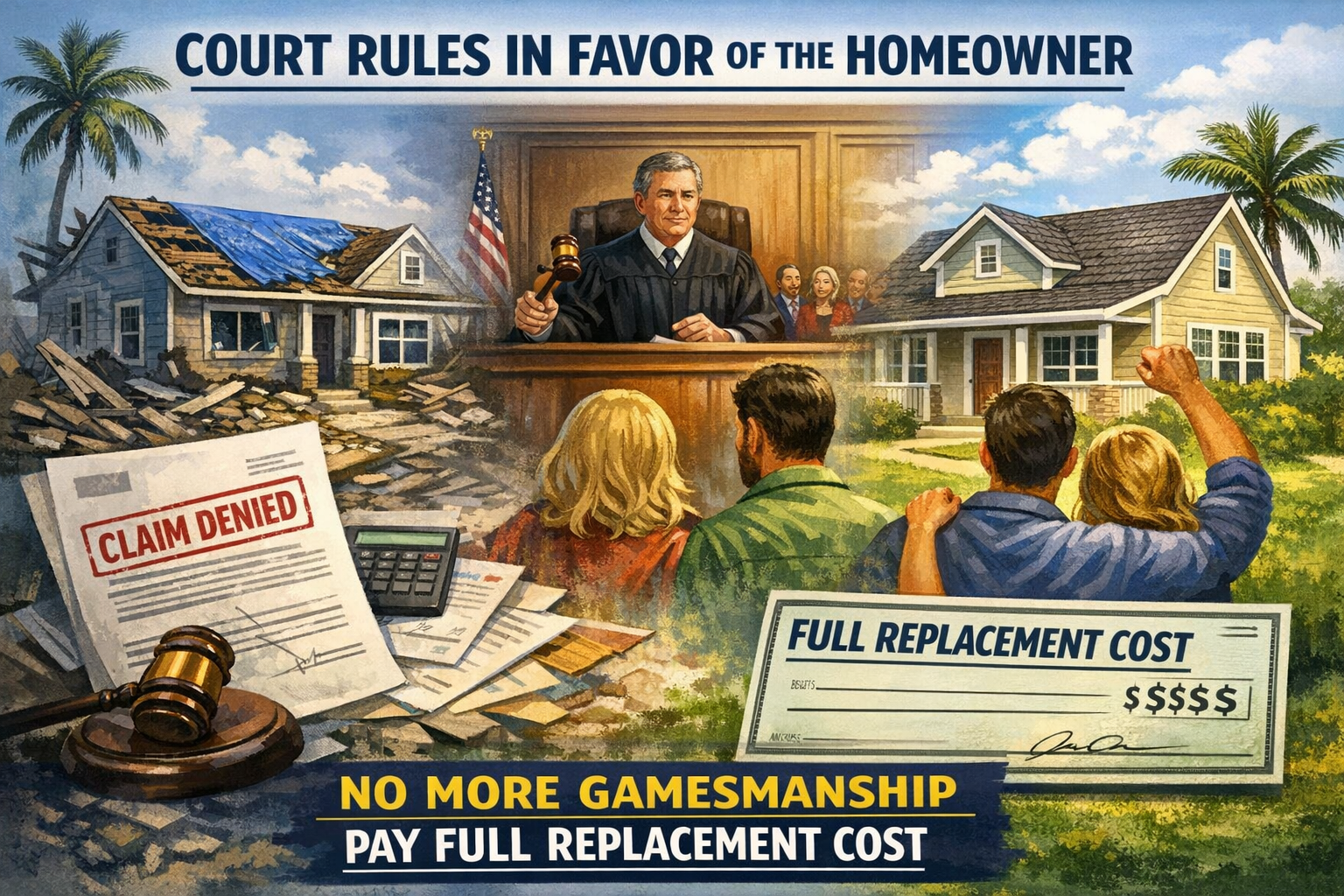
Here’s a scenario that might sound painfully familiar: Your Florida home suffers significant damage. You file a claim under your replacement cost coverage policy — the kind where the insurer is supposed to pay what it *actually costs* to rebuild or repair, not just what your aged materials were worth at the moment of loss. But instead of starting the claims process, your insurer sends you a denial letter.
Fast forward through months of frustration, legal fees, and stress. You take them to court. You win. The jury agrees the claim should have been covered all along.
Now here’s where some insurers try one last trick: They argue that because you didn’t complete repairs during the time they were wrongfully denying your claim, they should only have to pay you actual cash value — the depreciated amount — instead of the replacement cost they promised in your policy.
Think about the logic there for a second. The insurer denies your claim, deprives you of the funds you need to make repairs, forces you into litigation, loses in court, and then argues you shouldn’t get the full coverage you paid for because… you didn’t complete repairs while they were refusing to pay you?
Florida’s Sixth District Court of Appeal just said: **Not so fast.**
The Rodriguez Decision: Accountability Over Gamesmanship
In Universal Property & Casualty Insurance Company v. Rodriguez*, the court addressed this exact scenario. Universal issued a replacement cost policy. When loss occurred, they denied the claim outright. The homeowners sued. After a jury found in favor of the homeowners, Universal tried to argue that damages should be limited to actual cash value since the repairs hadn’t been completed.
The court wasn’t having it.
The decision makes a critical distinction that every Florida homeowner should understand: **Florida’s replacement cost statute governs how insurers handle covered claims, not how they escape liability after denying claims they should have paid.**
What’s the Difference Between ACV and RCV Anyway?
Let’s break this down in plain English:
– Actual Cash Value (ACV) = Replacement cost minus depreciation. It’s what your damaged property was worth at the time of loss, accounting for age and wear. If your 15-year-old roof gets destroyed, ACV pays for a 15-year-old roof’s value.
– Replacement Cost Value (RCV) = What it actually costs to repair or replace with new materials of like kind and quality. Same roof scenario, but RCV pays to install a brand new roof.
The difference can be thousands — sometimes tens of thousands — of dollars.
Florida law allows insurers handling replacement cost policies to pay ACV first, then pay the depreciation holdback (the difference between ACV and RCV) once you complete repairs. This makes sense when everyone’s acting in good faith and the claim is being properly adjusted.
But that framework falls apart when the insurer denies your claim altogether.
The “Deny and Downgrade” Tactic
Here’s the playbook some insurers try to run:
1. Issue replacement cost policies (which homeowners pay higher premiums for)
2. Deny claims when losses occur
3. Force policyholders into expensive litigation
4. If they lose at trial, argue the homeowner only gets depreciated value because repairs weren’t completed during the denial period
5. Pocket the difference between what they promised and what they’re now trying to pay
The Rodriguez court recognized this for what it is: an attempt to have it both ways. You can’t breach a contract by denying coverage, then use the consequences of your own breach to limit damages.
Why This Matters for Your Claim
When an insurer breaches your replacement cost policy by denying a covered claim, the legal question becomes: **What would they have owed if they’d performed as promised?**
The answer isn’t limited by whether you managed to scrounge up funds elsewhere to make repairs while fighting the denial. The answer is determined by the contract itself — the replacement cost policy you paid for.
As the court correctly noted, once a breach occurs, the damages inquiry is backward-looking and hypothetical. It asks what *should* have happened, not what the homeowner could cobble together while being wrongfully denied.
**An insurer cannot deny you the funds needed to repair, force you into court, and then penalize you for not having completed repairs with money they refused to give you.**
What You Can Do If Your Replacement Cost Claim Was Denied
If you’re facing a denial on a replacement cost policy, here are practical steps:
1. **Document everything.** Keep copies of your policy declarations, the denial letter, all correspondence, and estimates for repairs at replacement cost.
2. **Get a replacement cost estimate** from a licensed contractor or public adjuster, even if you haven’t completed repairs. This establishes what it would actually cost to make you whole.
3. **Don’t assume the denial is final.** Many denials are improper, and courts are increasingly holding insurers accountable for wrongful denials.
4. **Understand your timeline.** You typically have five years from the date of loss to file a lawsuit in Florida, but don’t wait — evidence degrades and witnesses’ memories fade.
5. **Consult with an attorney who focuses on property insurance disputes.** The earlier you get legal guidance, the better you can protect your rights and document your claim properly.
6. **Don’t accept ACV when you paid for RCV.** If your policy provides replacement cost coverage and the claim is covered, you’re entitled to replacement cost damages — especially if the only reason you haven’t completed repairs is because the insurer denied your claim.
The Bottom Line
You paid for replacement cost coverage. If your insurer denies your claim and you have to take them to court to get what they owed you in the first place, they don’t get to downgrade your coverage to actual cash value just because their wrongful denial prevented you from completing repairs.
The Rodriguez decision reinforces a fundamental principle: **Insurance companies don’t get to benefit from their own breach of contract.**
Does this mean every denied claim will automatically result in full replacement cost damages? No. Every case depends on its specific facts, policy language, and circumstances. But it does mean that insurers can’t use denial as a tactic to escape their replacement cost obligations.
If your replacement cost claim has been denied and you’re being told you can only recover depreciated value, that’s a red flag. The law may be on your side more than you think.
—
*Clint & Company, P.A. represents Florida homeowners, business owners, and policyholders in first-party property insurance disputes. If your claim has been denied or underpaid, call 407-212-7598 for a free consultation.*
**Case Citation:** *Universal Property & Casualty Insurance Company v. Rodriguez*, No. 6D2024-0764 (Fla. 6th DCA 2025)
**Disclaimer:** This blog post was drafted with AI assistance and reviewed by the attorneys at Clint & Company, P.A. It is provided for informational purposes only and does not constitute legal advice. Every case is different, and you should consult with a qualified attorney about your specific situation. Reading this post does not create an attorney-client relationship.